Category Archives: Pirates

Pirates in fiction: Richard Hughes, A High Wind in Jamaica

Pirate literature, and more recently pirate movies and TV shows, have shaped our ideas of what pirates are like. But they also remind us of aspects of piracy we are liable to forget. A High Wind in Jamaica (or, The Innocent Voyage), Richard Hughes’s 1928 novel, is more in the latter category than the former. For it is a rare piece of fiction that reminds us how mundane and ordinary pirates could be.
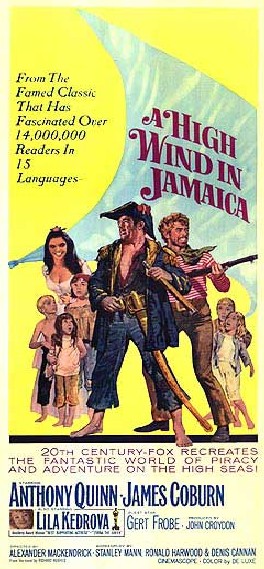
High_wind_movieposter

Somehow, they made this book into a movie, which is actually considered quite good by critics. I’m going to try to track down a copy to see both how good it is and how much they had to change the book to make the movie work.

The story is set sometime between 1833, when the slaves were emancipated in Jamaica, and 1860, which in itself is unusual. There had been a major wave of piracy in the Caribbean as Spain’s Latin American empire collapsed in the 1810s and 1820s; many of the pirates had claimed to be privateers operating under the authority of one short-lived Latin American rebel state or another. But the end of the Latin American wars of independence and vigorous efforts against the pirates by the American and British navies had put the vast majority of Caribbean pirates out of business by 1833.

Hughes knows this, and the portrayal of pirates in the story reflects the decay of their trade. The pirates claim to sail under a commission from Colombia, but even they know that’s a pathetic fiction. Their ship has no cannons, they never deliberately kill a single person during the entire story, and they never take a ship carrying treasure. In fact, the most valuable thing they find on either of the ships they do take are ship’s stores, supplies they need to keep their own ship in good order. As for what loot they find, they auction it off for a fraction of its value in a somnolent Cuban port that has seen better days. These pirates are so banal as to be tiresome. They are ordinary people who somehow got stuck with an illegal career. Walter White from Breaking Bad would make mincemeat of them.

Their comeuppance begins when they encounter the Clorinda, a barque carrying six children as passengers to England. The pirates take the children off as hostages to ensure the good behavior of the captain of the Clorinda. But he mistakenly assumes that the pirates have killed the children, and takes off with the Clorinda before the pirates can return the children. That sets the tone for the rest of the story: everybody not on the pirate ship believes the pirates are vicious creatures, while the pirates are desperately trying to find a way to get rid of the children without bringing the authorities down on them.

The real heart of Hughes’s story is his depiction of the children, which he portrays as thinking and acting very much unlike adults, to the mutual misunderstanding of both. Emily, the ten-year-old girl who dominates the story, finds the earthquake and the death of the family’s cat to be much more interesting events than her time among the pirates. When she is rescued and quizzed by authorities in England, her account of the pirates is about what she thinks important, not what adults would consider so, leading the authorities to despair of using her testimony to convict the pirates. Ironically, it is due to a misunderstanding the adults have about Emily that leads the pirates to be convicted of a murder which Emily herself unintentionally committed!

As a story about children, A High Wind in Jamaica is disturbing. As a story about pirates, it is a useful antidote to the common portrayals of pirates as romantic, heroic, or even comic swashbucklers. It is also a useful reminder that piracy was not confined to its “great ages,” and could be a humdrum and unprofitable affair.

Going to see the Whydah

The Whydah Pirate Museum

The Whydah Pirate Museum

In the early morning hours of April 26, 1717, Samuel “Black Sam” Bellamy, pirate commodore, died along with most of his crew when his ship, the Whydah, ran aground and broke up in a storm off Cape Cod, Massachusetts. In 1984, Barry Clifford found what remained of the wreck of the Whydah. It was the first pirate ship wreck from the “Golden Age of Piracy” to be discovered, and the first to have some of its treasures recovered. Clifford set up a museum on the wharf in Provincetown on the Cape to exhibit some of the recovered objects from the ship and to explain their significance. That’s where I went on August 12.

Cape Cod is a summer tourist spot, and its space and economy are structured accordingly. The south coast of the upper Cape is for kitschy family entertainment. I’d never seen a mini-golf course with multiple waterfalls, at least one 20 feet high, until we hit route 28 east of Hyannis. The north coast of the upper Cape is by contrast more rural and a bit quieter. The east coast of the lower Cape is enveloped by the National Seashore (the first one established), which keeps that stretch of the coast relatively unspoiled. There’s only one main road running the length of the lower Cape, and it tends to drop and add lanes seemingly at random. Expect to get caught in at least one traffic jam if you travel to the lower Cape in the summer. And that includes Provincetown, where the museum is. There’s a ferry from Boston to Provincetown, which sits at the very end of the Cape; it’s an alternative, albeit an expensive one, to driving there.

While Provincetown has a reputation as a gay-friendly community, it’s really a compact and walkable tourist trap. Every business is geared toward housing and feeding tourists, or finding other ways to separate them from their money for an experience. It’s the sort of place that would be fun to spend a day being a tourist in. But after a day or two, you’d either have to get away from downtown, or be bored stiff. (Though I could see spending a few months conducting a sociological study of the community.)

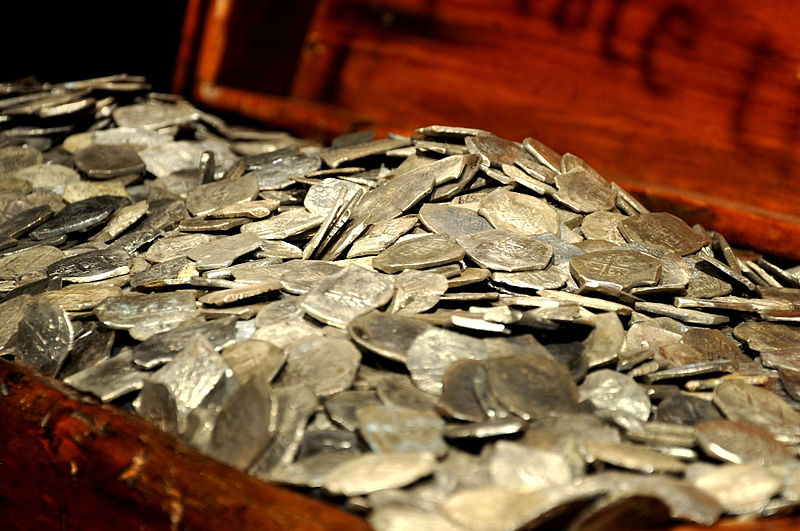
Whydah treasure

Whydah treasure (credit: Wikipedia/Theodore Scott)

The Whydah Museum sits on the same wharf as the ferry to Boston. I gather Clifford wanted to set it up elsewhere (Boston and Tampa were floated as possible sites), and still plans to build a bigger and more permanent museum. So this museum is a small one. Still, you can spend a few hours in it, if you watch the video, read the material posted on the walls, and examine the exhibits with some care.

The exhibits and the information posted on the walls are structured as self-contained modules, which can be examined in any order. That probably makes the museum easier to visit when it is crowded; one can skip from one display to another and eventually cover the whole museum without losing the thread of the story. On the other hand, it means there really isn’t a single story line running through most of the exhibits. If you don’t know who Bellamy was or have any other context to understand the exhibits, then definitely watch the introductory video. Otherwise you’ll be seeing a lot of information that you won’t be able to pull together unless you have an eidetic memory.

On the positive side, nowhere else (with one exception, see below) can you see exhibits from an actual pirate wreck, whether silver coins, cannonballs, or even the ship’s bell. And one of the three “rooms” of exhibits covers Clifford’s most recent project, to salvage the remains of a pirate ship that went down near Madagascar in the Indian Ocean. On the negative side, if you want to get a solid understanding of the Golden Age of Piracy, read a book instead. The information displays in the museum only cover some aspects of the subject, and doesn’t pull the pieces together.

The proof the wreck was the Whydah: its bell (credit: Wikipedia/jjsala)

The proof the wreck was the Whydah: its bell (credit: Wikipedia/jjsala)

Oh, the other place you can see exhibits from an actual pirate wreck? Some of the Whydah exhibits are on tour, including the famous ship’s bell. Catch it on tour, or wait until it returns, if you have your heart set on seeing the object that proved Clifford had found the Whydah.